Lorenzo Bonomelli (University of Vienna)
Changed for the last time in 26st April, 2026
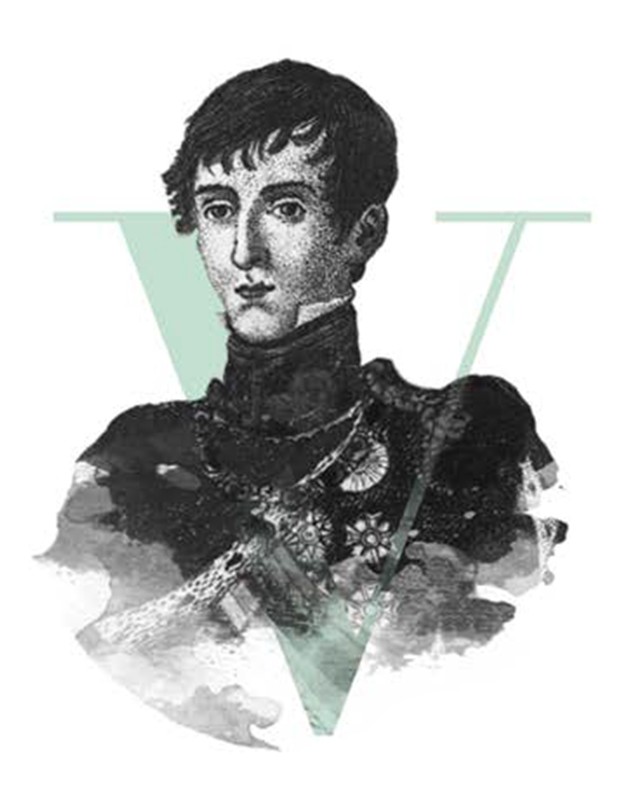
Albin Reine Roussin (21 April 1781 – 21 February 1854) was a French naval officer, diplomat, and Minister of the Navy and Colonies from May to October 1840 and from February to July 1843. In July 1831, he commanded the French naval attack on Lisbon, known in Portuguese as the Questão Roussin.
Born in Dijon, he joined the Navy in 1793. In the historical period of the French Revolution known as La Terreur (“The Terror”, 1793-1794), the public authorities saw Roussin’s enlistment as proof of his family’s patriotism and released his father, a lawyer who had been imprisoned as a suspected counter-revolutionary partisan (GRAVIÈRE 1888: 15-16). He entered service as a simple cabin boy in Dunkirk, a city on the English Channel (“la Manche”) at the forefront of the war between Britain and France. In the following years, he took part in several naval campaigns and missions on the coasts of Norway, Saint-Domingue (present-day Haiti), Ireland, and Brittany. In 1801, he became an officer candidate (“aspirant de première classe”) through a public competition. Rising rapidly up the naval ranks, he campaigned in the West Indies, the Indian Ocean, and then again in the Channel and the Atlantic throughout the Napoleonic wars (Biographie 1892: 1-15).
After the end of Napoleon’s Empire, the Bourbons were reinstalled on the throne by the other European powers. Roussin was expelled by the Navy due to his loyalty to Napoleon during the Cent-Jours (“The Hundred Days”, i.e., the short comeback of the emperor in 1815, from his escape from Elba Island to his final defeat at Waterloo). However, the Navy needed experienced officers, and Roussin was soon reintegrated after pledging allegiance to the Bourbon King Louis XVIII (signed oath, dated 20 September 1816, in ANF, LH, 2407/38, piece 5).
In the late 1810s, Roussin conducted two important hydrographic expeditions, charting the coasts of West Africa and Brazil (ROUSSIN 1826 and 1827). Hydrography – i.e., the cartography of coastlines and sea routes – was one of the main fields of action of the French Navy under the Restoration (1815-1830), also because other European powers still looked with suspicion at France and would not have allowed her to carry out any warlike activity. Moreover, historians have described hydrography as a “scientific appropriation of the world” (VENCENT 2023: 111-126). The detailed maps and descriptions produced by these expeditions formed a basis for the expansion of French commerce and sea power in the nineteenth century.
A further crucial task of the French Navy in the post-Napoleonic decades was the promotion of French trade, through operations purportedly aimed at protecting French merchants from the antagonism of hostile governments. This duty was entrusted to the permanent naval stations – often composed of just a handful of vessels – progressively instituted by the Parisian government in various regions of the world. Roussin was the first commander of the French naval station on the Atlantic coast of South America, based in Rio de Janeiro, from its establishment in 1821 to 1822, before reaching the continent’s west coast and founding the French naval station of the Pacific Ocean in the Chilean port of Valparaiso (GUTIÉRREZ ARDILA 2015: 149-151). In 1825, he was recalled to France to join the Admiralty Council (“Conseil d’amirauté”, the Navy minister’s inner advisory circle), but the French government sent him back to South America in 1828. Here, the Brazilian navy had blockaded Buenos Aires during the Cisplatine War (1825-1828), seizing seven French merchant ships. Roussin was tasked with claiming reparations for the French merchants damaged by these operations, which he obtained by entering with nine warships in Rio de Janeiro’s bay and threatening the city (Biographie 1892: 27-36 and 126-133).
After the Parisian Revolution of July 1830, which put an end to the Bourbon Restoration and installed the liberal constitutional monarchy of Louis Philippe, Roussin sat on several technical bodies of the Navy ministry. He was especially instrumental in establishing the Academy for Naval officers (“École navale”) in the French Atlantic port of Brest, which he supervised as the Naval prefect of the city.
In 1831, Roussin led a further early instance of what would be later called “gunboat diplomacy” (BARBER 2018). This time, the French operations targeted Portugal, consistent with the nineteenth-century Great Powers’ frequent naval threats and interventions not only outside Europe, but also against smaller and weaker states on the margins of the Old Continent (WAMPACH 2020: 99-126). Under the kingdom of Dom Miguel, several French residents and merchants claimed to suffer vexations from local authorities, such as arbitrary confiscation, imprisonment, the refusal of access to the port for merchant ships, and the lack of interest of Portuguese courts in complaints presented by French nationals. In a context of tense and unfriendly relations between the regimes of Dom Miguel and Louis Philippe (LEAL DE FARIA 2023: 223-228), French diplomatic protestations brought no result, and the Parisian government turned to naval coercion. A maritime blockade of Portugal from May 1831 proved ineffective. Therefore, a fleet of fifteen warships reached Lisbon at Roussin’s orders. On 11 July, this squadron crushed the defence system on the mouth of the Tagus and seized nine Portuguese warships (virtually Dom Miguel’s entire naval force). Under the threat of cannons, the Portuguese government indemnified the French citizens and paid a compensation of 800,000 Francs to the French government. It also consented to restore the privilege of a special judge for French nationals in Portugal (the juiz conservador) and dismiss some public servants accused of mistreating French citizens (see the verbete “Question Roussin”, forthcoming).
As a reward for his actions in Lisbon, Roussin obtained the rank of Vice-Admiral, and King Louis Philippe introduced him to the Chambre des Pairs (the French Parliament’s high chamber). From 1832 to 1839, he was appointed as the French ambassador to the Ottoman Empire. He was one of the main actors in the diplomatic negotiations over the Eastern Question, notably concerning the clash between Sultan Mahmud II and the Egyptian Pacha Mehmet Ali (OZAVCI 2021: 163-210).
Back in France, he served twice – briefly – as the Minister of the Navy and Colonies: first from May to October 1840, in a government led by Adolphe Thiers and characterised by exasperated nationalistic and bellicose tones in the context of the Eastern Crisis, and then from February to July 1843 (ZANCO 2011). As a minister, he contributed to the technological advancement of the Navy through the introduction of steam power, and the extension of French colonies in the Pacific Ocean (Marquesas and Society Islands).
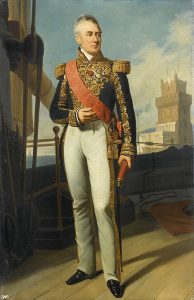
Louis Philippe made him Admiral – the highest French naval dignity – in 1840. On this occasion, the King commanded a portrait of Roussin for the Salles des Amiraux in the Versailles Palace. This painting testifies to the importance of the 1831 intervention in Lisbon. Roussin is depicted aboard a warship, with the Belém Tower and the furled Portuguese flag in the background (Image 1).
In the last years of his life, Roussin reduced his activities, especially in the political sphere, due to worsening health. Still, he remained involved in public life as a member of prominent scientific bodies. In 1827, he was admitted to the Société de Géographie de Paris, a savant organisation supporting geographic exploration and gathering the élites of France’s diplomatic, intellectual, political, commercial, and naval circles, which he also directed as its president in 1843 (FIERRO 1983: 244). The high reputation of his hydrographic works also earned him a seat in the Academy of Sciences of the Institut de France, Geography and Navigation section, and in the Bureau des longitudes, a specialised body in astronomical and geographical measurements, at the dependence of the French government (FRANQUEVILLE 1895: 220-221). Furthermore, Roussin devoted himself to writing, contributing to journals and magazines and penning memoirs of his career (Note 1844; Extrait 1848). His publications fit into a moment of increasing attention to the Navy and maritime questions, shedding light on the understudied participation of officers and military men in the public debate and their activity as authors.
As an Admiral, Roussin was automatically admitted to the Senate when Louis Napoleon restored the Empire in 1852. However, he was seriously ill and died shortly after, on 21 February 1854, aged 72.
Roussin’s biography illustrates the involvement of the Navy in building and rebuilding French world power in the first half of the nineteenth century. Roussin’s contribution to this task ranged from seas and ports worldwide to the highest levels of government in Paris, passing through several different regimes and connecting military, diplomatic, commercial, and scientific issues.
Sources
– ANF (Archives Nationales de France), LH (Légion d’honneur), 2407/38.
– Extrait des Mémoires inédits d’un vieux marin, Paris, Firmin Didot, 1848.
– Note sur l’entrée de vive force d’une escadre française dans le Tage le 11 juillet 1831, Paris, Firmin Didot, 1844.
– ROUSSIN, Albin Reine, Le pilote du Brésil, ou Description des côtes de l’Amérique méridionale situées entre l’Ile Santa-Catharina et celle de Maranhão; cartes et plans de ces côtes, et instructions pour naviguer dans les mers du Brésil; composé sur les documents recueillis dans la campagne hydrographique […] exécutée en 1819 et 1820, Paris, Imprimerie Royale, 1826.
– ROUSSIN, Albin Reine, Mémoire sur la navigation aux côtes occidentales d’Afrique, depuis le Cap Bojador jusqu’au mont Souyos d’après les reconnaissances hydrographiques faites en 1817, Paris, Imprimerie Royale, 1827.
Bibliography
– BARBER, Christopher Ernest, “Gunboat Diplomacy”, in The Encyclopaedia of Diplomacy, New York, John Wiley & Sons, 2018, https://doi.org/10.1002/9781118885154.dipl0114.
– Biographie de l’amiral baron Roussin, 1781-1854, Paris, Typ E. Plon, Nourrit et C., 1892.
– FIERRO, Alfred, La Société de géographie, 1821-1946, Geneva-Paris, Droz-Champion, 1983.
– FRANQUEVILLE, Charles de, Le premier siècle de l’Institut de France, t. I, Paris, J. Rothschild éditeur, 1895.
– GRAVIÈRE, Edmond Jurien de la, Les Gloires maritimes de la France: L’amiral Roussin, Paris, Plon, 1888.
– GUTIÉRREZ ARDILA, Daniel, “Les stations navales françaises en Amérique méridionale sous la Restauration”, Outre-Mers 386–387, n. 1 (2015), pp. 137–158.
– LEAL DE FARIA, Ana, Diplomacia portuguesa: a organização da actividade diplomática da Restauração ao Liberalismo. Os arquitectos da paz, Carnaxide, Tribuna da História, 2023.
– OZAVCI, Ozan, Dangerous Gifts: Imperialism, Security, and Civil Wars in the Levant, 1798-1864, Oxford, Oxford University Press, 2021.
– VENCENT, Hélène, “The Scientific Appropriation of the World: The Imperial Legacy in Naval Officer Training”, in Thomas Dodman and Aurélien Lignereux, eds, From the Napoleonic Empire to the Age of Empire: Empire after the Emperor, Basingstoke, Palgrave Macmillan, 2023, p. 111–126.
– WAMPACH, Christophe, Armed Reprisals from Medieval Times to 1945, Baden Baden, Nomos Verlag, 2020.
– ZANCO, Jean-Philippe, ed., Dictionnaire des Ministres de la Marine, 1689-1958, Paris, SPM, 2011, pp. 475–77.
Image
Charles-Philippe Larivière, Albin Reine, baron Roussin, amiral de France, 1841-1842, 2.18×1.45 m, Chateau de Versailles (source: Wikimedia commons https://commons.wikimedia.org/wiki/File:Roussin,_Albin.jpg)
